Our Starting Point
We chose this topic because we both have a personal connection to music. Drawing from our own musical experience we were able to explore music’s practical and emotional impact. Brieonda plays piano and guitar, and Violet has experience playing and teaching bass guitar.
For our project, we chose an audience of all ages because music and mental health affect people across backgrounds and levels of experience. Many people enjoy music daily without realizing the depth of scientific research behind its impact on emotional regulation, memory, mood, and overall well-being. Our goal is to educate readers, provide practical tools, and highlight the fascinating science connecting music and mental health.
To support different learning styles, we selected a wide variety of media, including academic articles, popular science pieces, videos, songs and a podcast. We focus on topics such as dementia, depression, stress relief, and general mental health.
We used several databases and search tools throughout our research process. Academic Search Complete was our starting point because it includes peer-reviewed work in psychology, music studies, and behavioural sciences. Google Scholar helped broaden our search and identify additional academic studies and citations. We also used general Google searches to find videos and other multimedia sources. At the beginning, our search results were often too broad and focused mainly on general music preferences, which did not directly relate to mental health. To address this, we refined our searches by adding more precise psychological terms and limiting results to titles and abstracts that were specifically about music. This significantly narrowed the results and helped us find more relevant material. We also explored areas such as dance and its relationship to psychology, since dancing and music are so closely connected.
Overall, we are happy with the variety and depth of the sources we found, and we hope this guide helps readers understand not only that music supports mental health, but also how and why it does. Our goal is to encourage people to engage with music as a meaningful tool in their own lives.

PourquoiPas. “Woman, Headphones, Music.” Pixabay, 9 Oct. 2015, pixabay.com/photos/woman-headphones-music-girl-smile-977020/
| Keywords identified for this topic: | |
| Music | First general term for research |
| Song | Pieces of music people connect with |
| Dance | Related expressive art form often studied alongside music |
| “Mental Health” | Second general term for research |
| “Mood Regulation” | Temporary state of mind relating to mental health & music |
| Psychology | The scientific study of the mind |
| Brain | Central organ involved in emotional processing and mental health |
| Neural | Relating to nervous system and brain |
| Behavior | Music often influences actions, habits, and social behaviors |
| Therapy | Connects the topic to clinical approaches, including music therapy and other mental-health treatments |
| Depression | Mood disorder characterized by persistent sadness and loss of interest |
| Cognitive | Mental processes of acquiring knowledge and understanding through thought, experience, and the senses. |
Below are some example search strings connected to our topic:
note: * represents a wildcard and XB means in the title or abstract
“music” AND (psychology OR “mental health”)
(“music* OR song*”) AND (mental OR psych* OR mood regulat* OR emotion OR brain)
(music* OR song*) AND (mental OR psych* OR mood regulat* OR emotion OR brain)
(music* AND (psychology OR brain OR neural OR behaviour OR “mental health” OR mood)
(music* AND (dementia or Alzheimer’s) AND (psychology OR brain OR neural OR behaviour OR “mental health” OR mood)
XB(dancing OR move AND music) AND (depression OR “mental health” OR cognitive)
Examples of our searches:
Using the search string XB(dancing OR move AND music) AND (depression OR “mental health” OR cognitive) we used one of our results which is about people who still feel the urge to dance despite having musical anhedonia.

Using the search string (music* AND (dementia or Alzheimer’s) AND (psychology OR brain OR neural OR behaviour OR “mental health” OR mood) we found the article “Why musical memory can be preserved in advanced Alzheimer’s disease”

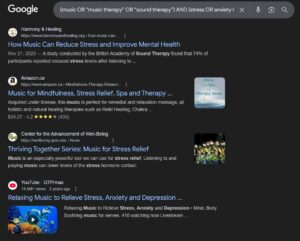
Here is a google search using the search string: (music OR “music therapy” OR “sound therapy”) AND (stress OR anxiety OR depression OR “low mood”) AND (“coping mechanism” OR “emotional regulation” OR “stress relief”)
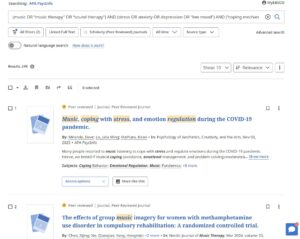
Here is a search done through the APA PsycInfo database using the search string: (music OR “music therapy” OR “sound therapy”) AND (stress OR anxiety OR depression OR “low mood”) AND (“coping mechanism” OR “emotional regulation” OR “stress relief”)